PLOS One, August 2014
‘Did you read my sms thoughts?’ could be a reality sometime in future. And the future might already be partly here. “Conscious Brain-to-Brain Communication in Humans Using Non-Invasive Technologies” sounds like a plot that could have been straight out of a James Cameron script book. 1) “Thoughts” from a person in Thiruvananthapuram, India, were recorded by surface EEG electrodes, 2) transferred via internet to France, 3) where they were “conveyed” to 3 people via Transcranial Magnetic Stimulation 4) and they interpreted them!!! Already received extensive media coverage though almost none referenced the original article. Immense potential for persons with communication impairments. Immense potential for ethical quagmire.
Scandinavian Journal of Medicine & Science in Sports, Sep 2014
When a BMJ blog exclaims “Plantar fasciitis- important new research”, adding “an exciting new paper that is the first of its kind and represents a new treatment approach” I thought somebody has found a solution to the problem. The original paper though was disappointing. The authors had compared high-load strength training against usual care of shoe inserts and stretches. Primary outcome of pain related symptoms were not different in both groups at 1 month, 6 months and 12 months. None of the secondary outcomes showed benefit with the new intervention. Yet, the authors conclude that their study “adds new evidence for the positive effect of a simple, progressive exercise protocol for (plantar fasciitis)”. Lessons: 1) In “conclusions”, state facts as they are. Not the way you want them to be. 2) It’s not dishonorable to report a negative study 3) do not go by authors’ conclusions, make your own from their tables and figures. 4) Do not be swayed by high regard for Scandinavian research or BMJ.
In the last month’s review, I’d promised a gift to anyone who could identify the glaring mistakes in another article on plantar fasciitis. There was just one response, and Abhita got it right. Cheers (finally, somebody responds).
Spinal Cord, September 2014
667 We’re getting closer to thanksgiving and having more than a fair share of Turkey this month. “Can spinal cord injury patients show a worsening in ASIA impairment scale classification despite actually having neurological improvement?” ask the Turkish authors before they launch their criticism on the limitations of ASIA Impairment Scale (AIS) Classification. The case examples they argue on are not uncommon, but that does not fully justify the article. We need to remember that the AIS has its advantages in allowing for a quick clinical survey, and that the Scale has never been a comprehensive assessment tool. Nothing beats a logical, complete neurological examination. We’ve had instances of post-graduate students found wanting in final exams if they fail to think beyond AIS. “We’re getting addicted to methods, in the process forgetting basic things that we’re supposed to do”- said Dr. Pathmeswaran, a soft spoken public health Professor from Sri Lanka in his speech at the Hyderabad Cochrane Colloquium last week. How true.
693 Can abdominal massage administered by a electromechanical device reduce chronic constipation and other bowel problems in SCI? The Dutch authors found that the answer was ‘No’. Perhaps it was an oversimplification of the neurological issue to a mechanical one?
697 Acute abdomen in a person with high SCI has the potential to send you on a wild goose chase. Guarding & rigidity, the classical signs without which the surgeon would refuse to enter the OR, would be absent. Imaging studies would be as helpful as the search operations for the missing Malaysian Airlines plane. Risk to life could be very high, as we realized the hard way in one particular instance I remember. This Turkish single center chart review study reports an incidence of about 4% (n=9) of acute abdominal emergencies in their cohort of 237 persons with SCI over five years. Gall bladder disease was the commonest cause. High clinical suspicion is warranted when there are subtle symptoms of unexplained gastroparesis and fever.
Practice tidbits
- Why should we continue our Multidisciplinary Biopsychosocial Rehabilitation (MBR) model of intervention for Chronic Back Pain? Because this cochrane review says “Patients with chronic low back pain receiving MBR are likely to experience less pain and disability than those receiving usual care or a physical treatment. MBR also has a positive influence on work status compared to physical treatment.”
- Silver alloy-coated or antibiotic-coated urinary catheters DO NOT reduce incidence of symptomatic catheter-associated urinary tract infections (CAUTI) says this Cochrane review. Such catheters seem to add to the cost significantly without offering any clinical benefit.
- Should Physiotherapy be Evidence-Based? This blog pleads so. So do I.
- This one stumped me. Is Methotrexate useful in treatment of Ankylosing Spondylitis? Based on 3 RCTs and 116 patients, the Cochrane Review concludes “There is not enough evidence to support any benefit of MTX in the treatment of AS” .
- One more Cochrane stumping. “Based on 23 trials, all at high risk of bias, there is insufficient evidence to establish the value of combination therapy over monotherapy for people with inflammatory arthritis. Importantly, there are no studies addressing the value of combination therapy for patients with IA who have persistent pain despite optimal disease suppression.” The more we try, the less we seem to know.
Liked in News
Workout while you work. One more of those why-didn’t-I-think-of-that innovations, the human hamster wheel might just set things in motion, literally, for the movement against ‘inactivity at workplace’.
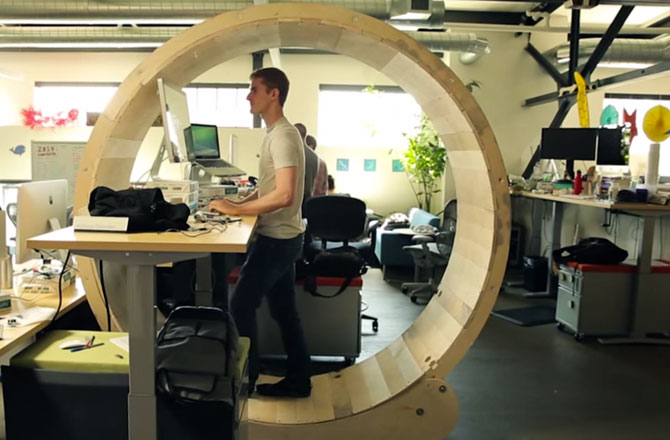
Source: new.discovery.com

 Rehab Journal Review